
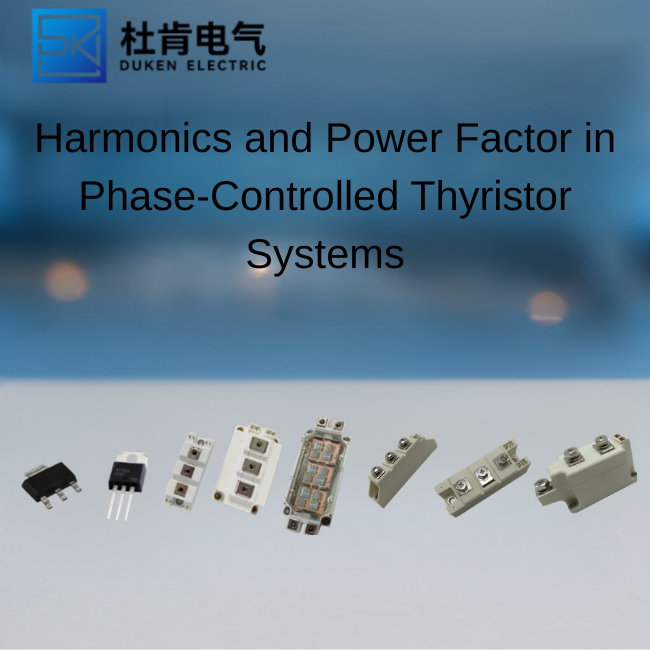
Harmonics and Power Factor in Phase-Controlled Thyristor Systems
Author: Selina
An industrial phase control dual thyristor module gives equipment designers a robust way to regulate high power in traction systems, plasma cutters, desalination plants, energy storage equipment, and industrial heating platforms. However, phase-angle control changes the input current waveform and can introduce harmonics, reactive power, and a lower power factor. For OEM engineers and purchasing teams, module selection must therefore consider more than current and voltage ratings. Trigger strategy, thermal design, surge capability, on-state voltage, cooling conditions, and grid compliance all affect system efficiency and long-term reliability.
Why Phase Control Creates Harmonics and Lower Power Factor
A phase-controlled rectifier regulates output power by delaying the firing angle of the thyristors during each AC half-cycle. When the firing angle is small, the devices conduct for most of the cycle and the system delivers relatively high output power. As the firing angle increases, conduction begins later and the average DC output falls.
This control method is simple, rugged, and suitable for high-current industrial equipment. The trade-off is that the input current is no longer sinusoidal. Instead, current flows in chopped segments. This distorted waveform contains harmonic components that increase RMS current, transformer heating, cable losses, and electromagnetic interference.
Power factor in these systems has two parts:
Displacement power factor, caused by the phase shift between the fundamental voltage and current
Distortion power factor, caused by harmonic current
A system may therefore have poor total power factor even when the fundamental phase shift appears acceptable. Buyers should ask whether quoted power-factor data refers to displacement power factor or true power factor measured under actual load.
Firing Angle and Grid Impact
At low firing angles, a phase-controlled converter usually has better power factor. At large firing angles, reactive power increases and the current waveform becomes more distorted. The exact result depends on load type, source impedance, transformer leakage inductance, smoothing inductance, and control algorithm.
For traction drives and industrial DC supplies, the design team should evaluate:
Total harmonic distortion of input current
Fundamental power factor
True power factor
Transformer K-factor or derating needs
Cable and switchgear RMS current
Compliance with local harmonic standards
Operation at partial load
These checks are especially important for large installations where several converters operate from the same bus.
Choosing a Dual Thyristor Module for High-Power Control
The module must be selected according to the real electrical and thermal stress. A high surge current low on-state voltage industrial phase control dual thyristor module is attractive because it can reduce conduction loss while surviving short-duration overloads.
Important parameters include:
Repetitive Peak Off-State Voltage
The module voltage rating must include margin for line variation, commutation spikes, transformer transients, and switching disturbances. A device used on a 400V or 480V AC system often requires a blocking rating well above the calculated peak line voltage.
Average and RMS Current
The current rating depends on the conduction angle, cooling method, and case temperature. A module marked for a certain average current may carry a different RMS current under phase-controlled operation. Procurement teams should request current-rating curves rather than relying only on the headline value.
On-State Voltage
Low on-state voltage helps reduce conduction loss. At several hundred amperes, even a small voltage difference can produce significant heat. For example, a 0.2V reduction at 300A can reduce instantaneous conduction loss by approximately 60W per conducting path.
Surge Current and I²t
Industrial systems may experience transformer inrush, short-term overload, motor starting, or DC-side faults. High surge-current capability is therefore essential. The I²t rating should be coordinated with upstream fuses and protection devices.
Gate Trigger Requirements
Gate trigger current, voltage, holding current, and latching current affect driver design. Trigger circuits must provide sufficient pulse amplitude and duration under low-temperature and high-noise conditions.
Thermal Design with DCB and Ceramic Base Packages
A DCB substrate temperature control energy storage high surge current low on-state voltage industrial phase control dual thyristor module combines high-current semiconductor chips with a direct bonded copper substrate. The copper layers provide current spreading and thermal conduction, while the ceramic layer provides electrical isolation.
DCB construction is widely used because it supports:
Low thermal resistance
High dielectric strength
Compact module design
Reliable chip attachment
Efficient heat spreading
Stable performance under power cycling
In energy storage converters, temperature control is critical because charge and discharge cycles can create repeated thermal stress. The module should be evaluated for junction-to-case thermal resistance, maximum junction temperature, case temperature limit, and power-cycling endurance.
A ceramic base traction semiconductor high surge current low on-state voltage industrial phase control dual thyristor module is particularly useful when the converter must withstand vibration, long duty cycles, and repeated load changes. Ceramic isolation allows the module baseplate to be mounted to a common heatsink while maintaining electrical separation.
Practical Cooling Requirements
The complete thermal path includes:
Semiconductor junction to module case
Module case to thermal interface material
Interface material to heatsink
Heatsink to air or coolant
The thermal design should consider worst-case ambient temperature, airflow reduction, dust accumulation, coolant temperature, and aging of thermal grease. Engineers should also verify mounting torque and baseplate flatness. Uneven pressure can increase thermal resistance and create localized hot spots.
Harmonic Mitigation and Power-Factor Improvement
The thyristor module itself does not correct harmonics. Harmonic performance depends on the converter topology, control strategy, and external filtering.
Line Reactors
AC line reactors reduce current peaks, limit di/dt, and improve the current waveform. They are simple and cost-effective, although they add voltage drop and cabinet space.
Passive Harmonic Filters
Tuned filters can reduce selected harmonic orders. They require careful system analysis because resonance with the supply network can create new problems.
Multi-Pulse Rectifier Topologies
Twelve-pulse or eighteen-pulse systems use phase-shifting transformers to cancel specific harmonics. They are effective in large industrial installations but increase transformer complexity and cost.
Active Harmonic Filters
Active filters inject compensating current to reduce harmonics dynamically. They work well with varying loads but add control complexity and capital cost.
Improved Control Algorithms
Digital firing control can maintain symmetric triggering, reduce DC offset, and improve operation under line imbalance. However, control improvements cannot fully eliminate the distortion inherent in phase-angle control.
For new systems with strict efficiency or harmonic limits, engineers may compare thyristor control with IGBT active front ends, MOSFET converters, or SiC-based rectifiers. These alternatives can offer better power factor and lower harmonics, but they usually involve higher cost, more complex control, and different protection requirements.
Application Analysis for Industrial Buyers
In traction systems, dual thyristor modules may be used in auxiliary converters, excitation equipment, braking circuits, and controlled rectifiers. The main priorities are surge capability, thermal cycling, vibration resistance, and long-term availability.
In plasma cutters, rapid load changes and strong electrical noise require reliable gate triggering, low thermal resistance, and robust overcurrent protection.
In desalination plants, converters may operate continuously in warm, humid, or corrosive environments. A traction plasma cutter desalination high surge current low on-state voltage industrial phase control dual thyristor module should be combined with sealed cabinets, controlled cooling, conformal coating where needed, and corrosion-resistant connections.
For energy storage applications, the module may control charging currents, DC bus power, or resistive load banks. Engineers should verify repetitive cycling capability and temperature stability rather than focusing only on one-time surge ratings.
Procurement and Supplier Qualification
Before approving a module, buyers should request:
Full electrical datasheet and characteristic curves
On-state voltage data at operating temperature
Surge current and I²t test conditions
Thermal resistance and power-cycling data
Gate trigger limits
Mechanical drawing and mounting torque
Isolation voltage data
RoHS and REACH documentation
Lot traceability
Change-notification procedures
Samples should be tested in the actual converter. Recommended tests include full-load temperature measurement, firing-angle sweep, harmonic analysis, surge testing, thermal cycling, and operation under low line voltage.
A standard SCR module may be suitable for moderate-duty applications, but a high-reliability dual module offers simplified assembly and matched internal devices. Compared with IGBT or SiC modules, thyristors generally provide lower conduction loss and stronger surge capability at line frequency, while offering less control flexibility and higher harmonic content.
Conclusion
An industrial phase control dual thyristor module remains a practical choice for high-current industrial power regulation, especially where ruggedness, surge capability, low conduction loss, and proven technology are more important than high-frequency switching. Successful system design requires careful analysis of harmonics, true power factor, thermal resistance, firing angle, protection coordination, and cooling. Buyers should evaluate the module as part of the complete converter rather than as an isolated component.
FAQ
1. Why does phase-angle control reduce power factor?
The delayed firing angle shifts the fundamental current and distorts the current waveform, reducing both displacement and distortion power factor.
2. Can a line reactor eliminate harmonics?
No. A line reactor can reduce current peaks and some harmonic content, but it cannot remove all harmonics.
3. Why is low on-state voltage important?
Lower on-state voltage reduces conduction loss and heat, which can improve efficiency and extend module life.
4. Is a ceramic base suitable for traction equipment?
Yes. Ceramic-base modules can provide electrical isolation, thermal conductivity, and good power-cycling performance when properly mounted and cooled.
5. When should an IGBT active front end be considered?
It may be preferred when low harmonics, near-unity power factor, bidirectional power flow, or precise control justify higher cost and complexity.
Related SEO Terms
industrial phase control dual thyristor module, dual SCR power module, phase-controlled rectifier, thyristor harmonic distortion, power factor correction, high surge current thyristor, low on-state voltage SCR, DCB substrate thyristor module, ceramic base power module, traction semiconductor module, plasma cutter thyristor, desalination power control, energy storage thyristor, industrial rectifier module, phase angle controller, harmonic mitigation, line reactor for rectifier, twelve-pulse rectifier, active harmonic filter, true power factor, displacement power factor, current total harmonic distortion, SCR firing angle, thyristor gate trigger, high current SCR module, power semiconductor supplier, industrial converter module, traction power electronics, rectifier thermal design, DCB ceramic substrate, low thermal resistance module, surge current I²t rating, thyristor module selection, industrial power quality, SCR module cooling, power cycling reliability, controlled rectifier supplier, OEM thyristor sourcing, industrial semiconductor distributor, phase control power module.
READ MORE:
300A Phase Control Thyristor vs IGBT, SiC, and Rectifier Solutions
Using 6500 V 300A Phase Control Thyristors in Large-Scale Heating Systems
Selecting a KP300A-6500V Thyristor for High-Voltage AC Power Regulators
Forced-Cooling Heat Sink Design for 300A Thyristors in Mining Equipment
DCB Thyristor Modules for Temperature-Controlled Energy Storage Systems
How to Read a 300A Phase Control Thyristor Datasheet for Industrial Power Systems