
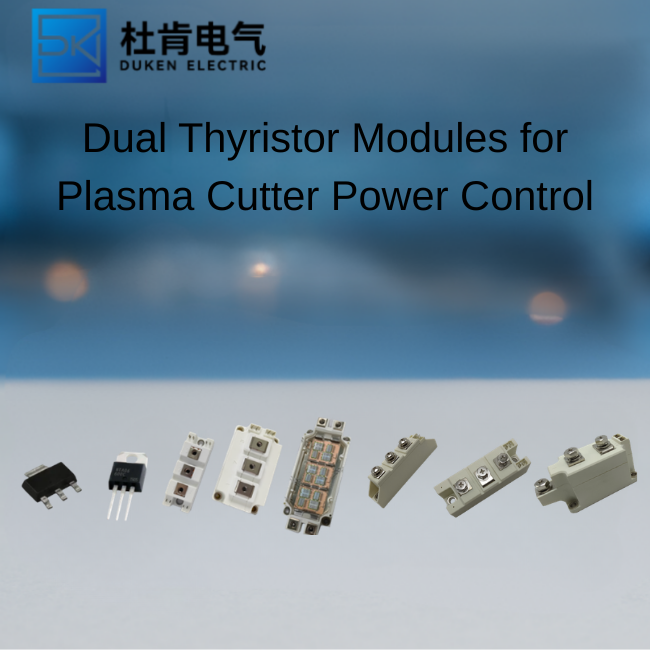
Dual Thyristor Modules for Plasma Cutter Power Control
Author: Selina
An industrial phase control dual thyristor module is widely used in plasma cutter power supplies where high current, repetitive switching stress, and strong electrical noise place heavy demands on the semiconductor stage. In these systems, the module must deliver stable phase control while tolerating transformer inrush, arc-start transients, high RMS current, and rapid load changes. For OEM engineers and purchasing teams, the most important factors are surge-current capability, on-state voltage, thermal resistance, gate-trigger reliability, and long-term consistency between production lots.
Why Plasma Cutters Need Rugged Thyristor Modules
Plasma cutting equipment converts AC input power into a controlled high-current DC output. In thyristor-based designs, the firing angle determines the average rectified voltage supplied to the cutting circuit. This provides a durable and economical way to regulate power in medium- and high-capacity systems.
The electrical environment is severe. Arc ignition creates short-duration voltage and current disturbances, while the cutting process introduces rapid load variation. The module may also experience repeated start-stop cycles throughout the working day.
A high surge current low on-state voltage industrial phase control dual thyristor module is valuable because high surge tolerance improves fault survival and low conduction loss helps control internal temperature.
Typical stress conditions include:
Transformer magnetizing inrush
Arc-start current peaks
Repetitive thermal cycling
Strong electromagnetic interference
High cabinet temperature
Dust and metal-particle contamination
Long operation at heavy load
The selected module should have sufficient electrical and thermal margin for all of these conditions.
Key Parameters for Model Selection
The headline current rating is not enough to determine whether a module is suitable for a plasma cutter.
Blocking Voltage
The repetitive peak off-state voltage must exceed the highest expected line and transient voltage. Engineers should include supply variation, transformer leakage inductance, snubber performance, and arc-start disturbances.
A higher voltage class may be necessary when the measured waveform contains large overshoot. Selecting a module too close to the maximum operating voltage can reduce reliability.
Average, RMS, and Surge Current
Phase-controlled current is non-sinusoidal, so RMS current may be significantly higher than average current. RMS current affects conduction loss and terminal heating.
The module should also provide adequate non-repetitive surge current and I²t capability. These ratings must be coordinated with fast semiconductor fuses so that the protection system clears a fault before the thyristor junction is damaged.
On-State Voltage
Low on-state voltage reduces conduction loss. At 300A, even a 0.2V reduction can lower instantaneous loss by approximately 60W in the conducting path.
However, buyers should compare voltage drop at the same current and temperature. A low room-temperature figure does not always indicate superior performance under real operating conditions.
Gate Trigger Characteristics
Plasma cutters generate strong electrical noise during arc initiation. The gate driver must provide reliable trigger current, sufficient pulse duration, and strong isolation.
Important values include gate trigger current, gate trigger voltage, holding current, and latching current. The control circuit should also prevent false triggering caused by dv/dt or common-mode interference.
Thermal Design and Ceramic Base Construction
A ceramic base traction semiconductor high surge current low on-state voltage industrial phase control dual thyristor module can also be applied in plasma cutting equipment because the ceramic base provides electrical isolation and an efficient path to the heatsink.
The thermal system includes:
Junction-to-case thermal resistance
Case-to-heatsink interface resistance
Heatsink thermal resistance
Airflow or liquid-cooling performance
Ambient cabinet temperature
A low thermal-resistance module will still overheat if the heatsink surface is uneven or the mounting torque is incorrect. Production teams should use controlled thermal compound thickness and calibrated torque tools.
DCB substrates can improve heat spreading and reduce local hot spots. They are especially useful in compact plasma cutter cabinets where cooling space is limited.
Comparison with IGBT, Bridge Rectifier, and SiC Options
A standard bridge rectifier is simple but cannot provide adjustable phase control. It is more suitable for fixed-output rectification.
IGBT modules provide faster control and high-frequency PWM operation. They may improve dynamic response and power factor, but they require more complex gate driving, protection, and control.
SiC modules can reduce switching losses and operate at higher frequency, but they are generally more expensive and may require tighter EMI and layout control.
For heavy-duty plasma cutter systems operating with phase-controlled rectification, the industrial phase control dual thyristor module remains attractive because it offers low conduction loss, strong surge tolerance, simple triggering, and proven industrial durability.
Procurement and Supplier Qualification
Before approving a supplier, buyers should request:
Electrical characteristic curves
Surge-current and I²t data
On-state voltage at operating temperature
Thermal resistance
Gate-trigger limits
Isolation-voltage data
Mechanical drawings
Mounting-torque instructions
Power-cycling results
Lot traceability and change-control procedures
Samples should be tested in the actual plasma cutter. Recommended validation includes arc-start testing, full-load thermal measurement, firing-angle sweeps, fuse coordination, vibration, and repeated thermal cycling.
Incoming inspection should verify dimensions, terminal quality, markings, forward voltage, gate behavior, and baseplate flatness.
Conclusion
A properly selected industrial phase control dual thyristor module can improve the reliability and efficiency of plasma cutter power supplies. The best choice combines high surge-current capability, low on-state voltage, stable gate triggering, effective ceramic-base thermal design, and verified supplier quality. Buyers should evaluate the module within the complete power stage, including fuses, snubbers, transformer, cooling, and control electronics.
FAQ
1. Why is surge-current capability important in plasma cutters?
Arc ignition and transformer inrush can create short-duration current peaks far above the normal operating level.
2. Can a bridge rectifier replace a dual thyristor module?
Not when adjustable phase control is required. A bridge rectifier provides uncontrolled rectification.
3. Why is low on-state voltage useful?
It reduces conduction loss, heatsink temperature, and cooling demand.
4. What should be checked in the gate driver?
Trigger current, pulse width, isolation, dv/dt immunity, and resistance to electrical noise.
5. What tests should buyers perform?
Arc-start testing, full-load thermal testing, surge verification, fuse coordination, and thermal cycling are recommended.
READ MORE:
300A Phase Control Thyristor vs IGBT, SiC, and Rectifier Solutions
Using 6500 V 300A Phase Control Thyristors in Large-Scale Heating Systems
Selecting a KP300A-6500V Thyristor for High-Voltage AC Power Regulators
Forced-Cooling Heat Sink Design for 300A Thyristors in Mining Equipment
DCB Thyristor Modules for Temperature-Controlled Energy Storage Systems
Harmonics and Power Factor in Phase-Controlled Thyristor Systems
How to Read a 300A Phase Control Thyristor Datasheet for Industrial Power Systems