
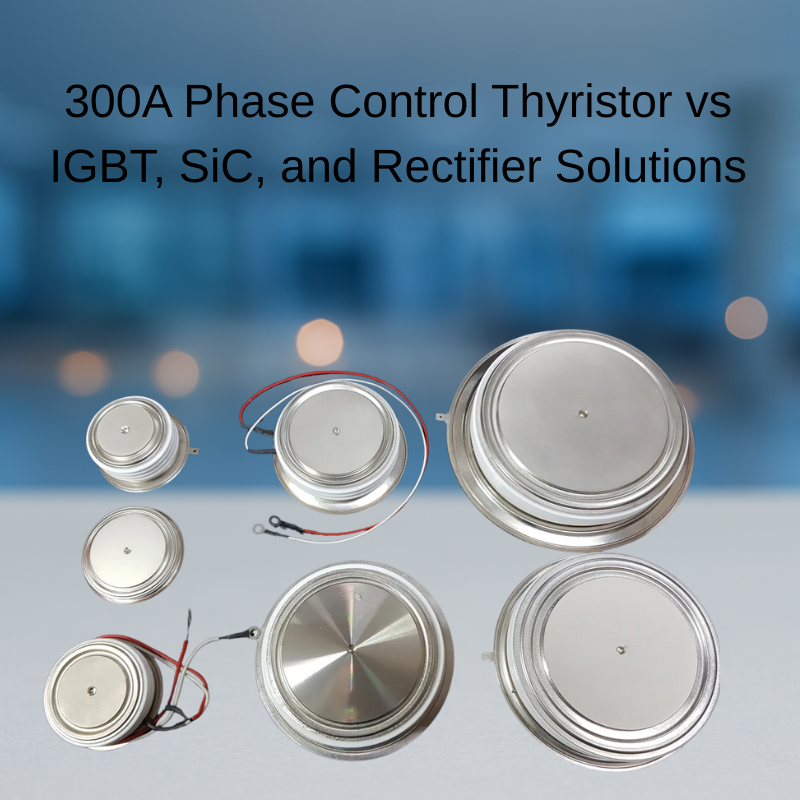
300A Phase Control Thyristor vs IGBT, SiC, and Rectifier Solutions
A 300A phase control thyristor remains one of the most practical devices for high-current, line-frequency industrial power control. Yet modern equipment designers also consider IGBT modules, SiC modules, MOSFETs, rectifier diodes, and bridge rectifiers. The correct choice depends on switching frequency, controllability, surge-current demand, conduction loss, cooling limits, and total system cost. For mining equipment, AC power regulators, transformer-primary control, and large-scale heating systems, comparing headline voltage and current ratings is not enough. Buyers must evaluate how each technology behaves under the real electrical and thermal duty cycle.
Where a 300A Phase Control Thyristor Fits Best
This operating principle makes the device especially suitable for:
AC power regulators
Industrial furnace and heater controllers
Motor soft starters
Transformer-primary control
Mining hoists, crushers, and conveyors
Controlled rectifier bridges
Crowbar and bypass protection
A KP300A-6500V 300A phase control thyristor can be attractive where high blocking voltage, strong surge tolerance, and low conduction loss are more important than high switching frequency. Its simple gate control and established protection methods also reduce engineering risk in long-life industrial platforms.
Key Thyristor Parameters
The most important datasheet values include:
VRRM and VDRM: repetitive reverse and forward blocking voltage
IT(AV): average on-state current
IT(RMS): RMS on-state current
ITSM: non-repetitive surge current
I²t: fault-energy capability for fuse coordination
VT: on-state voltage
RθJC: junction-to-case thermal resistance
di/dt and dv/dt: current-rise and voltage-rise limits
IGT: gate trigger current
A 300A phase control thyristor datasheet should always be checked for the exact test conditions behind these ratings.
Thyristor vs IGBT Module
IGBT modules are fully controlled switches. The gate can command both turn-on and turn-off, making them suitable for PWM inverters, motor drives, UPS systems, and medium-frequency converters.
Their main advantage is control flexibility. An IGBT can switch thousands of times per second, regulate current precisely, and reduce the size of transformers and filters.
However, at very high current and low switching frequency, an SCR often provides lower conduction loss. A thyristor may have an on-state voltage around 1 to 2 V under rated conditions, while an IGBT has a collector-emitter saturation voltage that may be higher at comparable current.
Surge capability is another difference. Thyristors are generally more tolerant of short-duration overloads and fault current. This matters in mining equipment, transformer energization, and heater cold starts.
Choose an IGBT when:
Active turn-off is required
PWM control is necessary
Switching frequency is above line frequency
Fast current regulation is important
Choose a thyristor when:
Line-frequency phase control is sufficient
Very high surge current is expected
Low conduction loss is a priority
Simple and proven control is preferred
Thyristor vs SiC Module and MOSFET
SiC Power Modules
SiC modules offer low switching loss, high-temperature capability, and fast switching. They are increasingly used in EV chargers, renewable-energy converters, aerospace power supplies, and compact industrial inverters.
For a 50 or 60 Hz AC regulator, however, these advantages may not justify the higher device and gate-driver cost. A SiC module can switch much faster than required, while the thyristor may still deliver lower total cost and strong overload performance.
SiC is preferable when:
High-frequency switching reduces transformer size
Efficiency at partial load is critical
Fast dynamic control is required
Space and weight are tightly constrained
A 6500 V VRRM 300A phase control thyristor remains more economical for many high-voltage heater regulators, mining controls, and transformer-primary applications.
Silicon MOSFETs
Silicon MOSFETs are excellent for low-voltage, high-frequency switching. Their conduction loss is resistive and described by RDS(on). At high voltage, however, resistance increases significantly. Achieving 6500 V and 300 A with silicon MOSFETs would require complex series and parallel arrangements.
MOSFETs are therefore best suited to lower-voltage DC systems, synchronous rectification, and high-frequency converters—not single-device high-voltage phase control.
Thyristor vs Rectifier Diode and Bridge Rectifier
A rectifier diode conducts automatically when forward biased. It is simpler than a thyristor and usually has low conduction loss, but it offers no gate control.
A diode bridge is suitable when fixed DC output is acceptable. A controlled thyristor bridge is better when the system requires:
Adjustable DC voltage
Soft starting
Controlled charging
Regulated heater power
Transformer inrush limitation
Bridge rectifiers are often supplied as compact modules, but high-current industrial designs may use separate press-pack diodes or thyristors for better cooling and serviceability.
In some systems, a mixed topology is used. Diodes handle the uncontrolled legs while thyristors control the firing angle. This semi-controlled bridge reduces cost and gate-driver complexity.
Thermal and Mechanical Selection
Regardless of device type, power loss must be converted into a junction-temperature estimate.
For a thyristor, conduction loss can be approximated by:
P = VT0 × IAVG + rT × IRMS²
Junction temperature can then be estimated as:
TJ = TC + P × RθJC
Press-pack thyristors often use double-sided cooling, which can produce very low thermal resistance. Correct clamping force is essential. Too little force raises contact resistance, while excessive force can damage the ceramic package.
IGBT and SiC modules generally use an insulated baseplate or DCB substrate. Their thermal performance depends on solder layers, ceramic material, thermal interface material, baseplate flatness, and mounting torque.
For a mining equipment power control forced-cooling heat sink 300A phase control thyristor, the design must also include dust, altitude, filter blockage, fan aging, and enclosure temperature. Thermal calculations based only on 25°C ambient conditions are rarely sufficient.
Application-Based Selection Guidance
Mining Equipment
Thyristors are usually preferred for soft starters, transformer controllers, and line-frequency regulators because of their surge tolerance and simple protection. IGBTs are better for variable-frequency motor drives.
AC Power Regulators
For heater and transformer control, anti-parallel thyristors provide efficient phase-angle regulation. IGBT or SiC converters are justified only when high-frequency PWM or superior power quality is required.
Large-Scale Heating Elements
Cold resistance and continuous duty favor the thyristor. Its low on-state loss reduces cooling demand and annual energy consumption. Burst control may improve power quality after startup.
Controlled Rectifiers
Thyristors provide adjustable DC output, while diodes provide fixed output. IGBT active rectifiers offer bidirectional power flow and improved input current quality but at higher cost and complexity.
Procurement Checklist
Industrial buyers should compare technologies using the same operating conditions:
Blocking voltage and transient margin
Continuous and RMS current
Surge-current capability
Conduction and switching losses
Junction temperature and cooling method
Gate-driver complexity
Protection requirements
Package and mounting method
Expected lifetime and cycling data
Supplier traceability and change control
A lower device price does not guarantee a lower system cost. The chosen technology affects heat sinks, fans, busbars, filters, gate drivers, protection, maintenance, and replacement availability.
Frequently Asked Questions
Is an IGBT always more advanced than a thyristor?
No. It is more controllable, but a thyristor may provide lower loss, stronger surge tolerance, and lower cost in line-frequency systems.
Can SiC replace a 6500 V thyristor?
Yes in some converter topologies, but the cost and control complexity may not be justified when only phase control is required.
Why not use a diode bridge for heater control?
A diode bridge cannot adjust output power. A thyristor regulator provides controllable firing angle and soft starting.
Which device is best for mining motor drives?
IGBTs are generally best for variable-frequency drives, while thyristors are effective for soft starters and line-frequency power controllers.
What is the biggest substitution risk?
Matching only voltage, current, and package size while ignoring surge rating, gate characteristics, thermal resistance, and cooling conditions.
Conclusion
A 300A phase control thyristor is not the best solution for every industrial converter, but it remains difficult to replace in high-current, high-surge, line-frequency applications. IGBTs and SiC modules provide superior switching control, MOSFETs serve lower-voltage high-frequency systems, and diodes offer simple fixed rectification. For mining equipment, AC power regulators, and large heating systems, the thyristor often provides the best balance of efficiency, reliability, and lifecycle cost. The final decision should be based on real current waveforms, switching frequency, cooling conditions, protection design, and supplier data—not technology trends alone.
SEO Keywords
300A phase control thyristor, 300A phase control thyristor datasheet, KP300A-6500V 300A phase control thyristor, 6500 V VRRM 300A phase control thyristor, thyristor vs IGBT, thyristor vs SiC module, thyristor vs MOSFET, thyristor vs rectifier diode, thyristor vs bridge rectifier, high voltage SCR, 300A SCR, industrial phase control thyristor, AC power regulator SCR, mining equipment thyristor, large heating element controller, controlled rectifier thyristor, press pack thyristor, disc thyristor, high surge current SCR, low on-state voltage thyristor, thyristor ITSM rating, thyristor I2t rating, thyristor RθJC, thyristor gate trigger current, SCR di/dt rating, SCR dv/dt rating, thyristor heat sink design, double-sided cooled thyristor, forced air cooled SCR, IGBT module comparison, SiC power module selection, industrial MOSFET application, rectifier diode module, bridge rectifier module, power semiconductor selection, B2B thyristor supplier, power semiconductor distributor, thyristor replacement model, industrial power control device, high reliability SCR
READ MORE:
Using 6500 V 300A Phase Control Thyristors in Large-Scale Heating Systems
Selecting a KP300A-6500V Thyristor for High-Voltage AC Power Regulators
Forced-Cooling Heat Sink Design for 300A Thyristors in Mining Equipment
DCB Thyristor Modules for Temperature-Controlled Energy Storage Systems
Harmonics and Power Factor in Phase-Controlled Thyristor Systems
How to Read a 300A Phase Control Thyristor Datasheet for Industrial Power Systems