
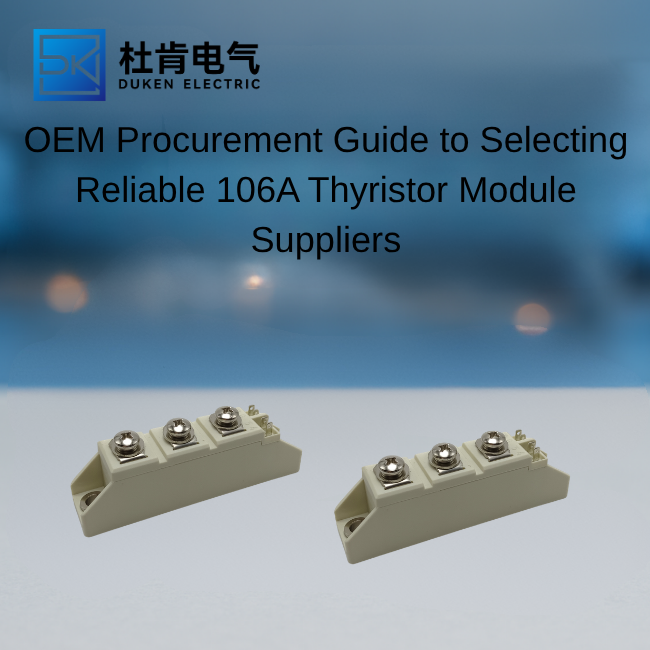
OEM Procurement Guide to Selecting Reliable 106A Thyristor Module Suppliers
For industrial OEMs, selecting among the recommended manufacturers and brands supplying thyristor modules is ultimately a supplier-management decision as much as a semiconductor-selection decision. Electrical performance determines whether a 106A module can operate in the UPS, but documentation, batch consistency, traceability, lead time, replacement support, and communication determine whether the supplier can support production for years.
This distinction becomes important when purchasing a certified full-module hard-soldered-joints 106A thyristor module for UPS systems. The buyer needs evidence behind the construction and certification claims rather than relying on a product description alone. For a water-cooling anti-parallel phase-control 106A thyristor module for UPS systems, the supplier must additionally understand topology, mechanical integration, and thermal-interface requirements.
What Should an OEM Ask a Thyristor Module Manufacturer Before Ordering?
The first conversation with a potential supplier should establish whether the manufacturer understands the application.
If a buyer requests only “106A 1600V thyristor module,” a technically capable supplier should normally want to know more before recommending a replacement.
Is the device used in controlled rectification, UPS bypass, AC switching, soft start, or another power-control circuit? What is the original model? Is the customer looking for a direct replacement or designing new equipment? What topology is required? What cooling method is used?
These questions reduce selection errors.
The technical documentation should then support the recommendation.
For a 106A module, the datasheet should allow engineers to evaluate parameters such as IT(AV), IT(RMS), VRRM/VDRM, ITSM, on-state characteristics, dv/dt, di/dt, IGT/VGT, thermal resistance, junction-temperature limits, and internal topology.
Mechanical information is equally important for replacement projects.
A dimensional drawing should identify the package footprint, mounting holes, terminal arrangement, and other dimensions needed to compare the module with the existing assembly.
When sourcing a certified full-module hard-soldered-joints 106A thyristor module for UPS systems, procurement should also request relevant evidence concerning the claimed construction and certification.
The objective is not to collect certificates for marketing purposes. The objective is to establish whether the supplier's documentation supports the OEM's actual quality and application requirements.
A supplier that cannot clearly explain its own module specifications creates additional qualification risk, even if its quotation is attractive.
Production Consistency Matters More Than a Perfect Sample
Sample testing is essential, but it has limitations.
A few carefully selected modules may perform perfectly in the customer's UPS. Volume production introduces a different question: can the manufacturer reproduce the same electrical and mechanical characteristics across multiple batches?
This is where supplier qualification becomes important.
The OEM should evaluate whether the manufacturer maintains controlled production specifications and appropriate testing procedures. Traceability is particularly valuable when the modules will be installed in equipment with a long service life.
Suppose 500 modules are installed and two devices later experience field failures.
Without traceability, the investigation may stop at the failed model number.
With suitable batch information, the supplier and customer can ask better questions. Did both devices originate from the same production lot? Are other devices from that lot operating normally? Did the failures occur in the same circuit position? Were the operating conditions similar?
This information helps distinguish isolated events from possible recurring patterns.
Thermal consistency also matters.
Consider two production batches with significantly different on-state characteristics. At 85A average current, an effective VT increase from 1.32V to 1.47V changes the simplified conduction loss from:
1.32 × 85 = 112.2W
to:
1.47 × 85 = 124.95W
That represents approximately 12.75W of additional heat.
If an OEM's thermal design already operates close to its target limit, unexpected variation can reduce operating margin.
This is one reason recommended manufacturers and brands supplying thyristor modules should be evaluated for production control rather than sample performance alone.
For long-term UPS programs, repeatability has commercial value.
Water-Cooled Anti-Parallel Modules Require Supplier Engineering Support
Some module requirements are difficult to purchase effectively through a simple part-number transaction.
A water-cooling anti-parallel phase-control 106A thyristor module for UPS systems is a good example.
First, the topology needs to be correct.
Anti-parallel thyristors allow controlled conduction in opposite directions across an AC circuit. This is different from a common-cathode dual-SCR configuration or a thyristor/diode combination.
A supplier recommending a replacement should therefore verify the internal circuit rather than assuming that modules with similar housings are interchangeable.
Next comes thermal integration.
Water cooling can provide strong heat-removal capability, but the semiconductor module is normally mounted to a cold plate through a thermal interface. Heat must travel from the junction through the module structure and mounting interface before reaching the coolant.
If a module dissipates 120W and its Rth(j-c) is 0.20°C/W:
ΔTj-c ≈ 120 × 0.20 = 24°C
A low cold-plate temperature can provide valuable thermal margin, but it does not compensate for every installation problem.
Baseplate contact, mounting practice, thermal-interface material, coolant temperature, flow distribution, and the heat from neighboring devices all influence actual operating temperature.
The supplier should therefore be able to discuss these conditions with the customer's engineering team.
Mechanical compatibility is also part of supplier value.
If an alternative fits the customer's existing cold plate, busbars, mounting holes, and gate connections, it can significantly reduce qualification cost.
If it requires major mechanical changes, the OEM should include those costs when comparing quotations.
For specialized products, application engineering support can therefore be worth more than a small unit-price difference.
Evaluate the Supplier's Response When Something Goes Wrong
After-sales capability is one of the most overlooked criteria in semiconductor procurement.
Every industrial component can eventually be involved in a field failure. The important question is how the supplier responds.
A professional manufacturer should not automatically claim that every failure is caused by the customer's application. Equally, a technically responsible supplier should not automatically classify every damaged SCR as a manufacturing defect.
Failure analysis should begin with evidence.
Useful information can include the failed quantity, total installed quantity, production batch, operating time, circuit position, voltage and current conditions, cooling method, gate-control information, photographs, and the circumstances immediately before failure.
For a certified full-module hard-soldered-joints 106A thyristor module for UPS systems, a returned-product investigation may also consider whether the failure pattern is consistent with thermal, surge, gate, mechanical, or internal component stress.
The conclusion should distinguish confirmed findings from possible causes.
This approach matters commercially because simply replacing a failed module does not necessarily solve the customer's problem.
If excessive junction temperature caused the damage, another identical module may fail again. If unstable gate triggering is involved, the firing circuit requires attention. If repeated voltage transients exceed the protection margin, the snubber or surge-protection design may need review.
Strong after-sales engineering therefore reduces repeat failures.
For procurement managers developing a list of recommended manufacturers and brands supplying thyristor modules, previous technical response and problem-solving capability should become part of supplier evaluation.
Build an Approved Supplier Strategy Around Application Risk
Not every thyristor purchase requires the same sourcing strategy.
A distributor stocking common modules may prioritize price, inventory availability, product range, and commercial flexibility.
An OEM designing modules into a UPS platform should place greater emphasis on technical consistency, lifecycle availability, change control, and engineering support.
For critical applications, a primary supplier plus a qualified second source can provide a useful balance.
The second source should be approved before an emergency occurs.
This does not mean the alternative must be identical internally. It means the OEM has verified that its electrical, thermal, mechanical, and gate characteristics satisfy the application.
Technology should also be considered in context.
Rectifier diodes remain appropriate where uncontrolled rectification is required. SCR modules provide controlled turn-on and are effective for phase control, bypass, soft-start, and controlled rectification.
IGBT modules provide active high-frequency switching and are typically better suited to PWM inverter stages. SiC MOSFET modules can offer lower switching losses and higher-frequency capability where the converter is designed to use those advantages.
These technologies should not be treated as interchangeable alternatives based on current rating.
For an established UPS using a 106A SCR, qualifying another SCR manufacturer is usually much less disruptive than redesigning the circuit around IGBT or SiC.
For a new platform, however, technology selection and supplier strategy can be developed together.
This broader approach helps procurement avoid both technology lock-in and unnecessary redesign.
Conclusion
Creating a list of recommended manufacturers and brands supplying thyristor modules should involve more than identifying famous semiconductor companies or comparing quotations.
For OEM buyers, a reliable supplier needs to provide the correct product, repeat it consistently, document it clearly, deliver it predictably, and support technical investigation when problems occur.
A certified full-module hard-soldered-joints 106A thyristor module for UPS systems should be evaluated through both technical data and evidence supporting its manufacturing and quality claims.
A water-cooling anti-parallel phase-control 106A thyristor module for UPS systems requires even closer cooperation between procurement and engineering because topology, thermal performance, mechanical compatibility, and cooling integration must all be verified.
The strongest sourcing strategy combines a clear technical specification, representative sample testing, production consistency, traceability, lifecycle planning, and a qualified alternative source.
For UPS manufacturers, industrial equipment OEMs, distributors, and purchasing managers, this approach changes supplier selection from a price comparison into long-term risk management—and creates a much stronger foundation for reliable power semiconductor sourcing.
FAQ
Q1: What should an OEM check before approving a thyristor module manufacturer?
Review the datasheet, topology, electrical ratings, thermal characteristics, dimensions, gate parameters, quality documentation, production consistency, traceability, lead time, and technical support.
Q2: Is successful sample testing enough to approve a supplier?
Not necessarily. Samples establish initial compatibility, but OEMs should also consider whether volume production can maintain consistent electrical and mechanical characteristics.
Q3: Why is after-sales support important for thyristor modules?
Because a failed SCR may result from semiconductor, thermal, electrical, gate-control, installation, or application factors. Technical failure analysis can help prevent recurrence.
Q4: Should UPS manufacturers have a second thyristor supplier?
For important or long-life products, a qualified second source can reduce risks associated with shortages, long lead times, discontinuation, and unexpected supply interruptions.
Q5: Can a cheaper IGBT replace a thyristor module?
Not simply because its current and voltage ratings are similar. IGBTs have different switching and gate-control characteristics, so changing from SCR to IGBT generally requires system-level engineering.
READ MORE:
Technical Selection Criteria for 106A Thyristor Module Manufacturers in UPS Projects
Supply Chain Reliability: Choosing Thyristor Module Brands for Long-Term UPS Production
How to Qualify Alternative Thyristor Module Manufacturers for 106A UPS Applications
Recommended Thyristor Module Manufacturers and Brands for UPS and Industrial Power Systems
2026 Thyristor Module Market Outlook: Pricing, Reliability and Technology Competition in UPS Systems
Second-Source Pricing Strategy for 106A Thyristor Modules in UPS Manufacturing
Water-Cooling Trends and Pricing of 106A Anti-Parallel Thyristor Modules for UPS Systems
Cost Drivers Behind 106A Thyristor Modules: Hard-Soldered Construction and UPS Reliability
Thyristor Module Price Analysis and Market Trends for UPS and Industrial Power Systems